The geometry of an agent
Norwegian farm huts are rigid where physics doesn't negotiate, and free where life changes. The agents I am building seem to need the same rule.
I am spending my summer in Norway with a book: Norwegian Wood, Jerri Holan’s study of the country’s timber buildings. It’s full of farm huts that all look the same and are all different, and it took me a while to understand how both things can be true.
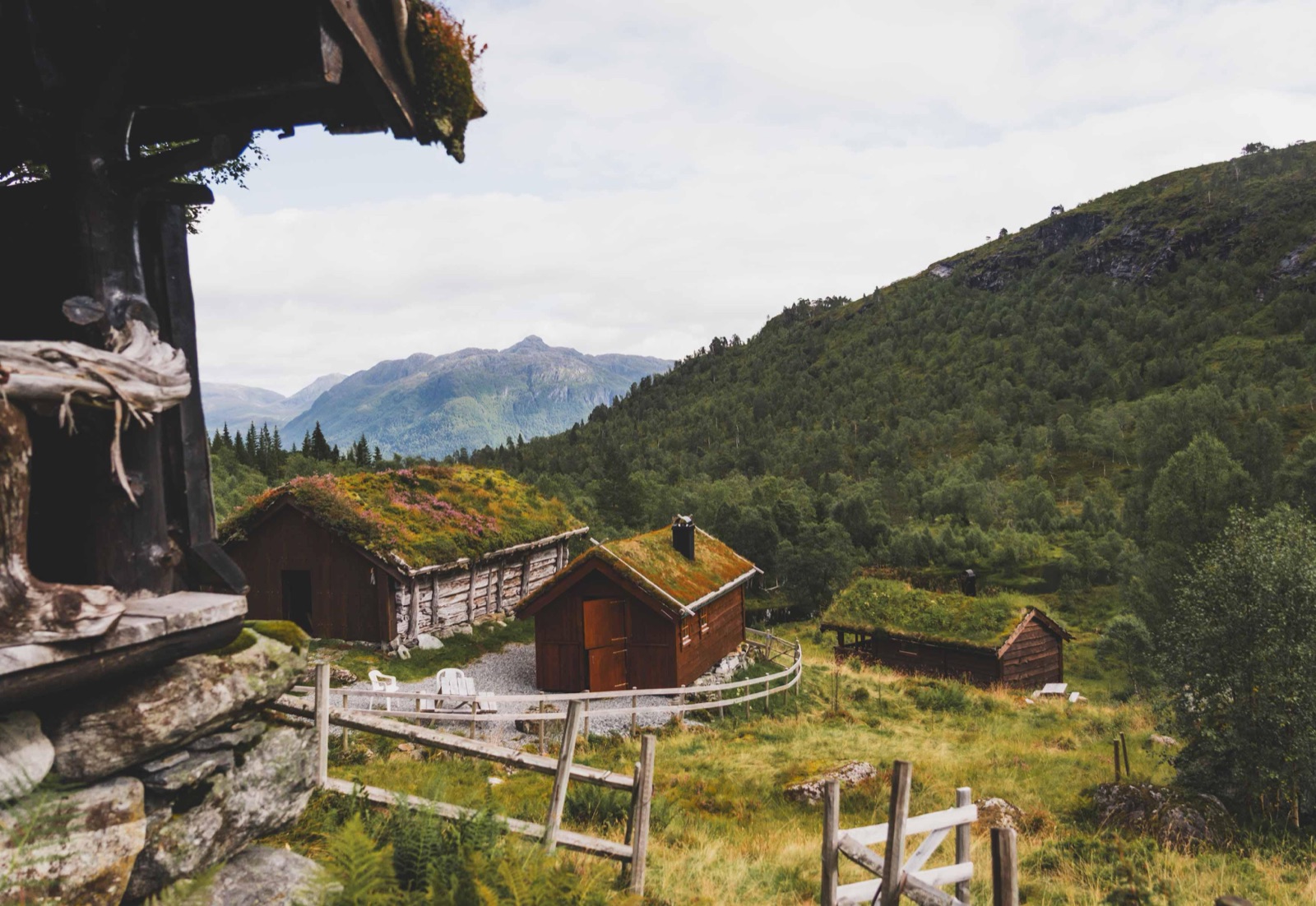
You can read one of those huts three ways.
Topology. A Norwegian farm is a tun: a loose ring of small houses, one per function. A house for living, a stabbur for food, a barn for animals. When life changed, nobody renovated; they added a hut. The farm is a graph that grew one node at a time, and what mattered was what stood next to what.
Morphology. The stabbur stands on mushroom-shaped stilts because mice exist. The roof is made of grass to provide insulation. Less urgent now, given electricity is basically free in Norway: 88% renewable energy from hydropower, thanks to the abundant waterfalls everywhere in the country. But that is another (interesting) story.
Geometry. Log lengths set the module. The notched corner joint is exact or the wall leaks. The roof pitch is fixed by snow. Every measure that physics cares about is locked, and has been for centuries.
Rigid where physics doesn’t negotiate, free where life changes. The tun absorbed four hundred years of new needs because the geometry lived in the joints, and the topology stayed loose, so new needs could always find a place.
Agents seem to want the same rule: rigid structures at the input and the output. Loose inside, so the architecture can keep up with what customers ask next.
At CommerceClarity we build AI agents that manage catalogs. So we have a fixed geometry at the boundary: one typed contract per workflow, same inputs and outputs for every customer. And we keep the interior topological: inside the contract, we rewire each customer’s graph freely, adding and removing steps like huts in a tun. And because the shapes at the boundary never move, we can test every run against the last one. Evals are built on the assumption that this geometry lasts.
Some principles came out of this. I think they go beyond agents for catalogs.
Fix the joints, free the rooms. The corner joint was a solved problem, the same in every hut. A new hut was pure repetition: cheap, even movable, logs numbered and rebuilt somewhere else. So the farm grew one hut at a time, without ever touching the others. Same with software: lock the interfaces, and adding a piece is repetition, not a project.
Humans read topology, machines check geometry. People will understand your agent as a story of connected steps. Your test suite understands it as fixed shapes. A good template is the joint between the two.
The huts survived four hundred Norwegian winters by knowing what to lock and what to leave loose. It may not be the definitive architecture, but I am going back home having seen what great architecture looks like, that is for sure. And I would be happy to get 10% of that right in how we are building agents. That should be enough to cross the chasm.